

Chandrayaan-3 Propulsion Module Slips Back Into Moon’s Gravity Zone
Chandrayaan-3’s Propulsion Module unexpectedly reenters Moon’s gravity, offering rare data on Earth-Moon orbital dynamics and spacecraft motion.
image for illustrative purpose
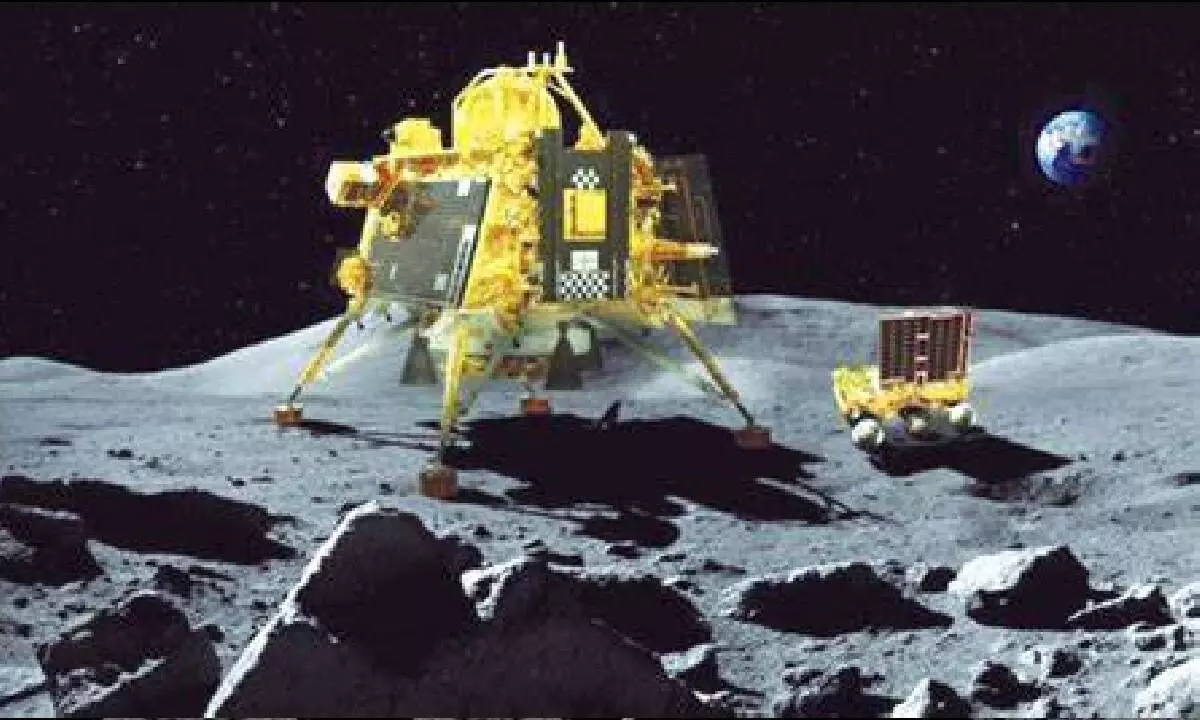
In a surprise twist, the Chandrayaan-3 Propulsion Module, on an extended Earth-bound journey, has returned to the Moon's gravitational influence, affording researchers a rare opportunity to study the interplay of Earth and lunar gravity on a drifting spacecraft.
Launched originally to return to Earth's orbit after completing its historic soft landing and rover operations, the module has been orbiting the planet at distances between 100,000 km and nearly 300,000 km since October 2023. What was intended as a routine post-mission trajectory experiment has now evolved into a unique observation of deep-space gravitational dynamics.
On November 4, it entered the Moon's Sphere of Influence, where the Moon's gravity started to predominantly take over the module's trajectory. ISRO's ISTRAC team followed the motion closely, with the peculiar shift in the trajectory noted for the first time. Scientists compared it with "watching an old visitor return unexpectedly," adding how unpredictable long-duration space operations are.
Two Close Lunar Flybys
The Propulsion Module performed two recorded lunar flybys last week:
Nov. 6, 2025, at 12:53 IST : Closest approach of approximately 3,740 km above the lunar surface.
Nov. 12, 2025, at 04:48 IST: Closest approach of approximately 4,537 km, visible to the Indian Deep Space Network.
ISRO further confirmed that both passes were accomplished without disturbing other lunar orbiters and that the satellite's systems remained fully operational throughout.
Following the flybys, the module’s trajectory increased considerably. Its previous 100,000 km by 300,000 km orbit extended to 409,000 km by 727,000 km, while its orbital inclination adjusted from 34 degrees to 22 degrees. What this means is that with every orbit, the spacecraft goes much further into space. ISRO stressed that ongoing monitoring of its encounters with other objects beyond Earth’s immediate vicinity continues.
While it has been mostly ignored in public discourse since its mission back in 2023, the module has nonetheless served as an unplanned long-term testbed for space research.
The recent lunar reentry now gives data about multiple key aspects of spacecraft dynamics:
Competing Earth and lunar gravity influence on a free-floating module
Disturbance torques affecting the orientation of space vehicles
Predicting uncertain deep-space trajectories
Refine mission planning based on insights gained from real long-duration operations. The transitions, which continuously shift the module between different gravitational zones, are complex and fluidly accomplished in space operations. ISRO expects to exit the Moon's Sphere of Influence once more on November 14 and begin its larger Earth-bound orbit.





